Quantum Technology
Superconducting Device Development
Transition-edge sensors are a standard detector technology used in modern astronomy instruments, and can also be used as single-photon detectors for quantum information and other applications. A TES is a superconducting bolometer that operates at the edge of the superconducting transition, where its resistance is highly sensitive to changes in temperature. When coupled to an absorber, this makes it an extremely sensitive detector for photons and other particles. Typically, a SQUID (superconducting quantum interference device) is used to read out the very small changes in electrical current through the TES that correlate to photon absorption. However, SQUIDs are complex devices, requiring fabrication of multiple layers of superconducting thin films, and they are not straightforward to multiplex. This limits the size of TES arrays, which in turn limits the sensitivity and resolution of instruments that use them.
At Caltech and JPL, I worked under Prof. Jonas Zmuidzinas and Dr. Peter K. Day, who had pioneered a new, highly scalable superconducting detector technology called the microwave kinetic inductance detector (MKID). These are superconducting microwave resonators where the inductance is dominated by kinetic inductance, a property that exists in all conductors but is particularly strong in superconductors. They can be fabricated with a single layer of superconducting material and are straightforward to multiplex, as resonators in a large array can be designed with slightly different resonant frequencies, with the whole array excited and read-out via a frequency comb on a common feedline.
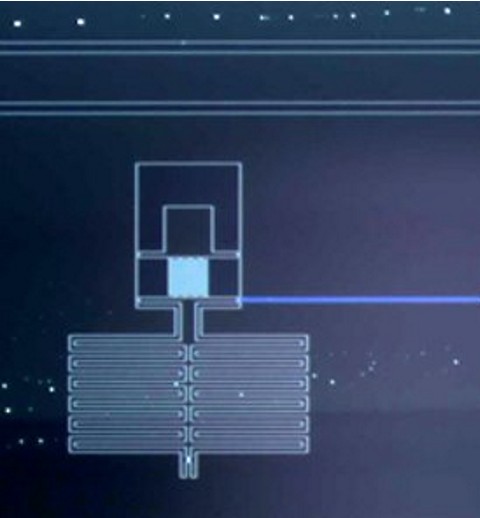
The group had also been investigating a nonlinearity in the kinetic inductance; namely, that the kinetic inductance has a dependence on the current flowing through the material. For my PhD work, I built on this research and took inspiration from MKID technology in order to develop a novel superconducting current sensor consisting of a microwave resonator with a nonlinear kinetic inductance. This device could be an easily multiplexable alternative to SQUIDs for reading out TESs, which retain some advantages over MKIDs. We named it the kinetic inductance parametric up-converter (KPUP), as it up-converts the low-frequency TES current signal to the microwave domain, where there is much greater available bandwidth for array multiplexing. Like SQUIDs, the added noise from the KPUP, which in principle dissipates no energy, could be quantum-limited.
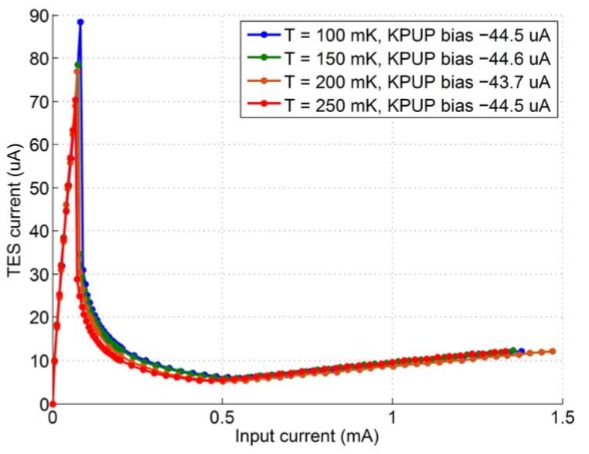
I designed and simulated KPUP devices and tested them in a dilution refrigerator with a microwave measurement setup. I measured the device response to DC current bias and observed the expected nonlinear kinetic inductance behavior, and then measured the noise referred to the input signal current, meeting performance benchmarks for TES readout. I then integrated the KPUP with a TES and was able to map the TES superconducting transition by using the KPUP to read out the current through the TES as I varied its temperature. I also demonstrated operation of a KPUP device as a parametric amplifier by applying a strong microwave pump tone and observing almost 30 dB of microwave gain with near-quantum-limited noise. This has applications for superconducting qubit readout as well as in other domains where low-noise microwave amplification is needed.
This work was presented at several conferences and published in the Journal of Low Temperature Physics. A detailed description along with that of a few smaller projects can be found in my PhD thesis.
Qubit Test System Monitoring
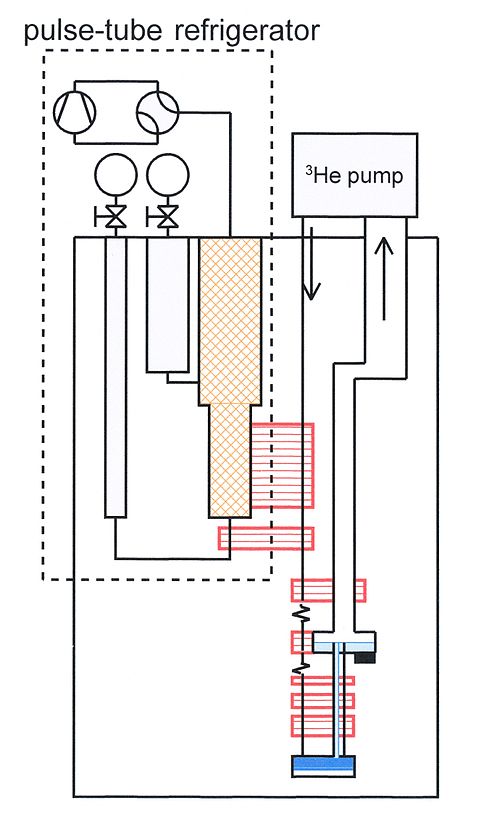

At HRL Laboratories, I was part of one of the most advanced semiconductor-based quantum computing programs in the world. As the program grew, there was a need to gain a better understanding of the various factors limiting qubit test throughput, particularly as it related to the health of the dilution refrigerators used for testing. Dilution refrigerators are complex systems1 with many components2, such as pumps, that can impact performance and cause downtime if they fail. Unfortunately, there was no comprehensive data on the health of the test system fleet.
In the absence of real health data, I developed a stochastic model in Python of the test system fleet, simulating the impact of various factors such as component and facility failure rates, repair times, and system cycling on overall test system uptime. The model was used to identify the likely largest factors contributing to downtime, and to estimate the potential impact of various mitigation strategies. These results contributed to high-level discussions on possible upgrades to the test infrastructure.
Eventually a data pipeline was developed to collect real health data from the test systems, which was stored in an Elasticsearch database. I used the Elasticsearch API in Python to reduce the complex health data into high-level system and fleet uptime metrics. I also fused the data with qubit test information stored in a SQL database in order to determine detailed qubit test throughput metrics. Finally, I developed Grafana dashboards to visualize the uptime and throughput metrics, in order to allow program leadership to monitor the test fleet in real time and identify opportunities for improvement.
Spin Qubit Magnetic Noise Mitigation
The spin qubits being developed at HRL are based on the spin of an electron confined in a semiconductor quantum dot. One of the main sources of error for these qubits is magnetic noise from the surrounding environment, which can cause decoherence and reduce qubit performance. The exchange-only qubit design being pursued at HRL is in fact insensitive to uniform magnetic fields, but magnetic field gradients across the quantum dot array can still cause qubit errors. These gradients can be caused by nuclear spins in the semiconductor material, nonuniform external magnetic fields, or even uniform external fields via screening or flux trapping from local superconducting material.
I was part of a team focused on reducing external sources of magnetic noise. I used COMSOL to perform finite element simulations of possible magnetic shield designs in order to enclose the qubits and screen Earth’s magnetic field and those from laboratory sources. After the shields were fabricated, I installed them in a test cryostat and validated their performance at cryogenic temperatures. I also assisted qubit test teams with other magnetic hygiene concerns.
Due to the presence of ferromagnetic componentry, I also performed extensive COMSOL simulations of the local magnetic field environment of the qubits. This effort extended to a Python simulation code that I wrote in order to model random and microscopic effects from this local ferromagnetism. The simulations were used to design mitigations related to the ferromagnetic componentry, which were then implemented and integrated with qubit devices. Validation was provided by qubit test teams, who observed improvements in qubit performance after the designs were implemented.
This work contributed to results in a recent preprint.